
Your soybeans may look healthy. SCN could still be costing you thousands
Your soybeans may look healthy. SCN could still be costing you thousands

As the Minnesota soybean harvest wraps up, it is an important time to look beyond the yield monitor and consider what may be happening below ground. Soybean cyst nematode (SCN) is the leading yield-limiting pathogen of soybeans in North America. It can reduce yields by up to 30% without obvious above ground symptoms. Soil sampling this fall, or in early spring before planting, can help farmers identify the problem and make better decisions for the next soybean crop (crop rotation, seed variety selection and seed treatments).
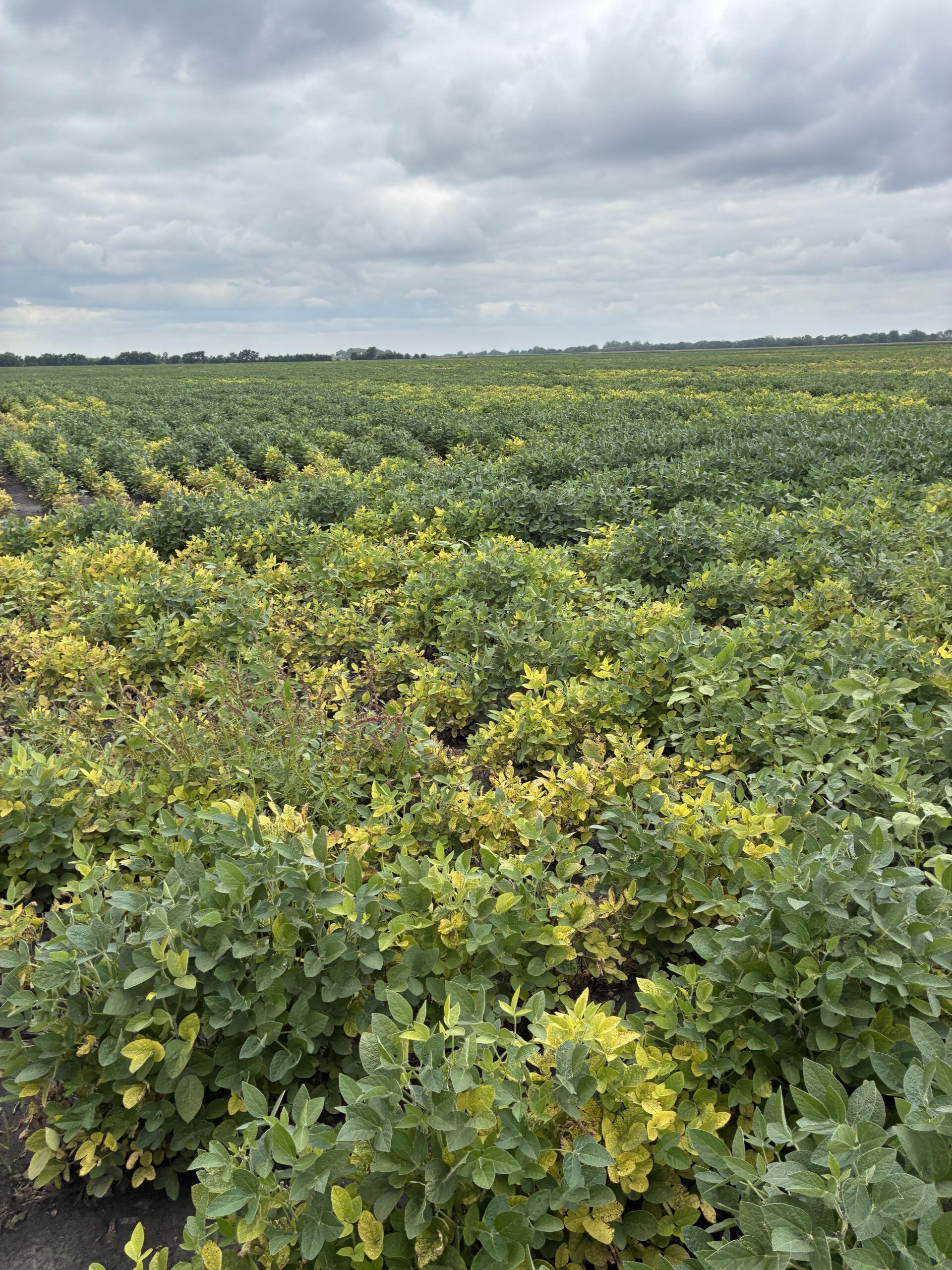
Figure 1. Foliar symptoms associated with soybean cyst nematode (SCN), including chlorosis and stunting, observed in a localized area in August. Although these symptoms may resemble iron deficiency chlorosis (IDC), their persistence later in the growing season may indicate SCN damage. Northern Minnesota, August 2025.
A hidden enemy below ground
SCN (Heterodera glycines) is a microscopic, plant-parasitic roundworm that feeds on soybean roots, interfering with water and nutrient uptake. Affected plants may show yellowing, stunting, uneven growth or early maturity, especially under stress such as wet spots, high-pH soil and iron deficiency chlorosis (IDC) areas. However, a healthy-looking field can still have damaging SCN populations. During the growing season, carefully digging up soybean roots may reveal tiny white or yellow, lemon-shaped SCN females attached to the roots. They are much smaller than nitrogen-fixing nodules. Inspecting plants and roots helps, but a soil test is the most reliable way to identify and monitor SCN.
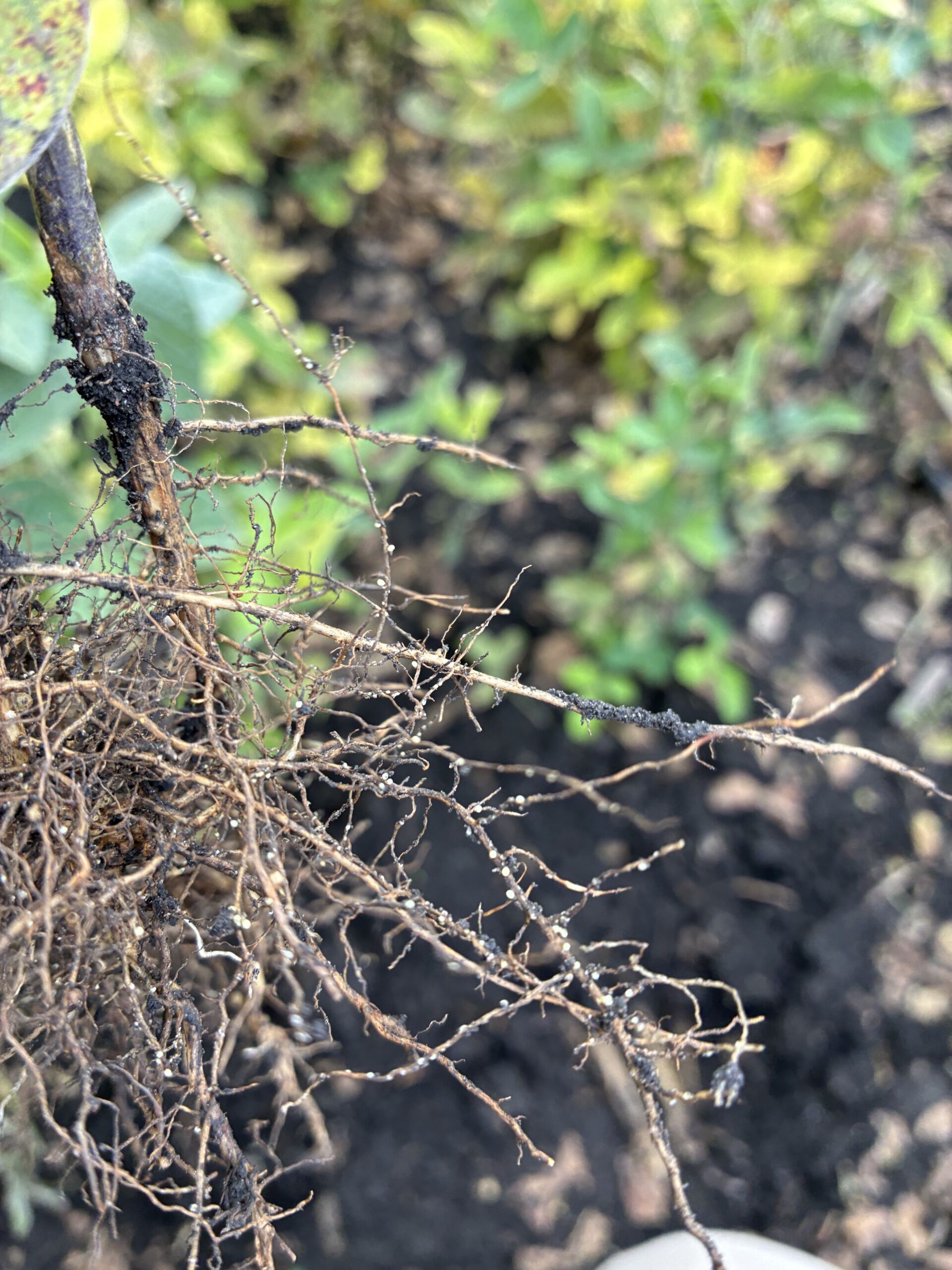
Figure 2. Soybean roots showing visible SCN females and cysts. We carefully dug up plants to preserve the root system and allow close inspection. Although SCN juveniles are microscopic, you can see mature females (Cysts) with the naked eye. Northern Minnesota, August 2025.
Know your numbers
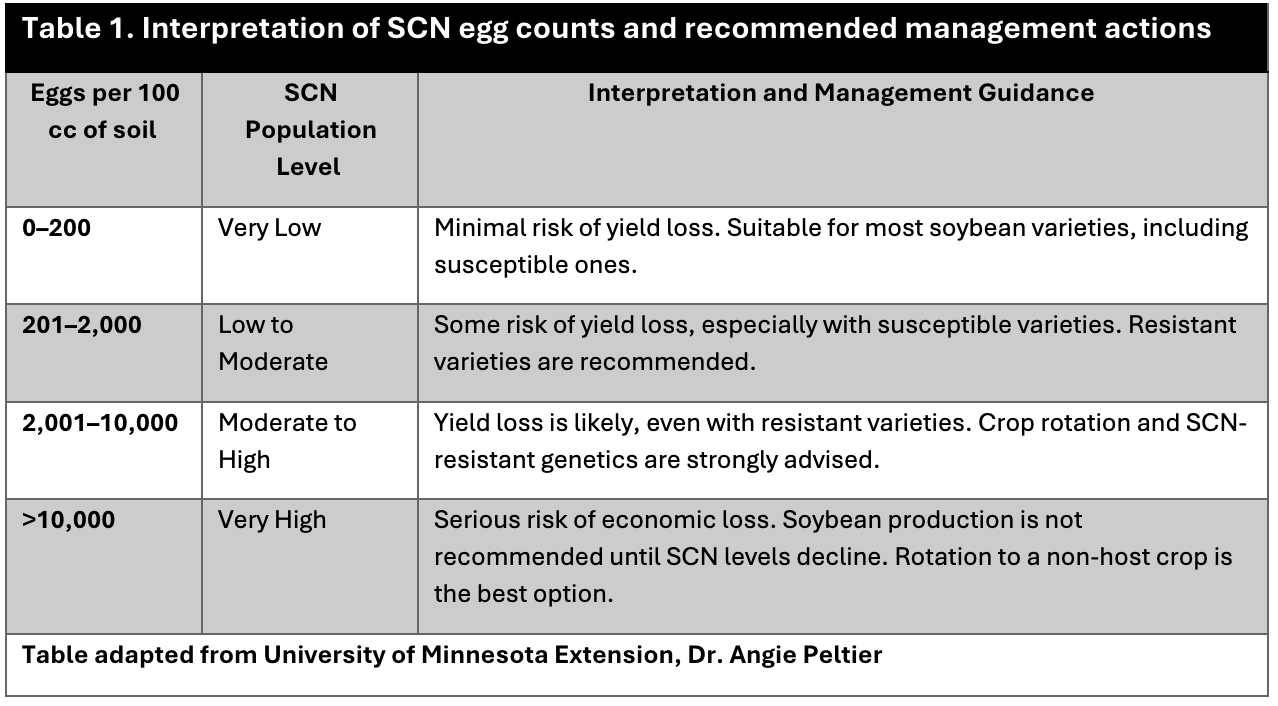
SCN egg counts are reported as eggs per 100 cubic centimeters (100 cc) of soil. These numbers help estimate infestation pressure and guide soybean variety selection and crop rotation. Low counts do not mean zero risk, and yield loss depends on the soybean variety, SCN population, soil conditions and weather. Repeated testing also shows whether management is moving egg counts in the right direction.
What could SCN cost on your farm?
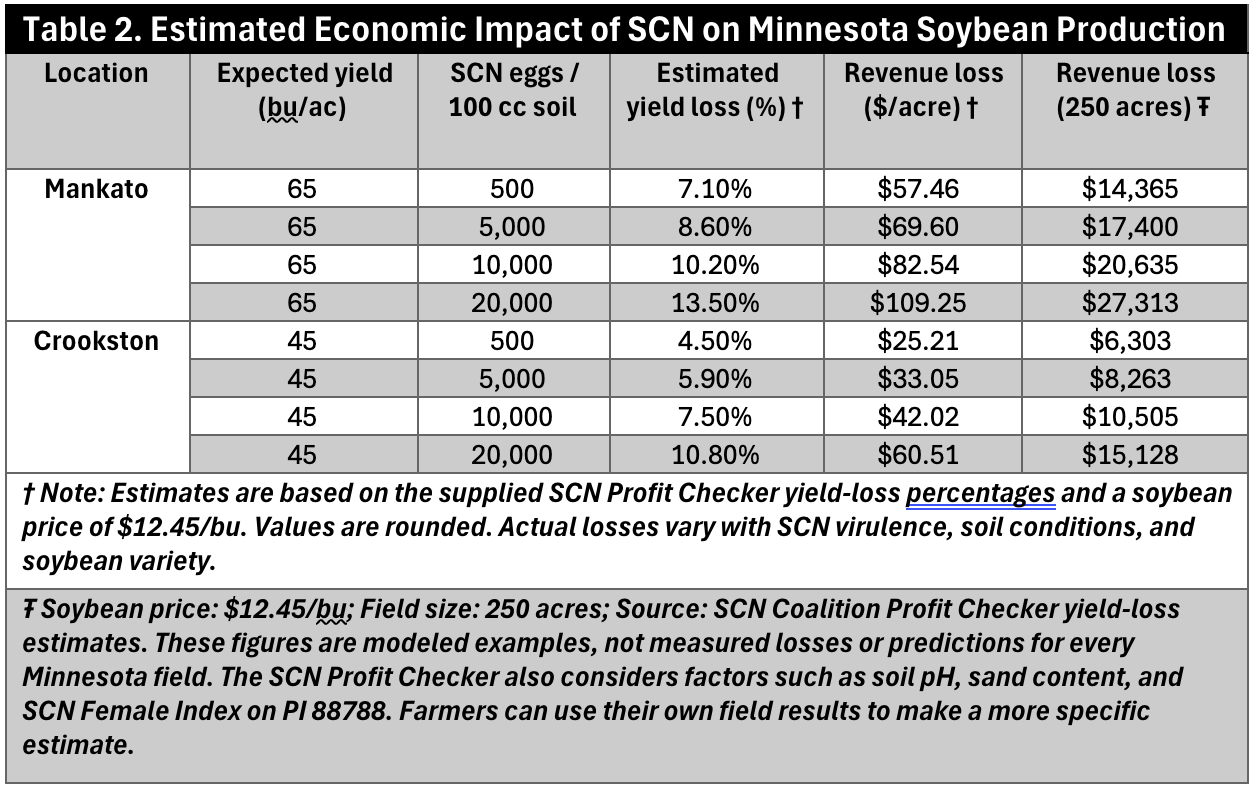
The economic impact of SCN becomes clearer when you express yield losses in dollars. Using The SCN Coalition’s Profit Checker and a soybean price of $12.45 per bushel, two illustrative Minnesota scenarios demonstrate how quickly these losses can add up. In Mankato, with an expected yield of 65 bushels per acre, estimated revenue losses range from $57 to $109 per acre. At the highest SCN population evaluated (20,000 eggs per 100 cc of soil), this represents a 13.5% yield loss, equivalent to approximately $27,300 in potential gross revenue lost across a 250-acre field. In Crookston, with an expected yield of 45 bushels per acre, estimated losses range from $25 to $61 per acre. At the same SCN population, a 10.8% yield loss could cost approximately $15,100 across 250 acres.
These examples demonstrate that SCN can significantly affect soybean profitability, even when plants show no visible symptoms. This is why crop rotation, selecting soybean varieties with effective SCN resistance and using appropriate nematode-protectant seed treatments are important components of an integrated management strategy. Regular soil sampling helps farmers understand SCN populations, make informed decisions, protect yield potential and reduce economic losses.
Management starts with a plan
Once SCN is established, it cannot be eradicated. Effective management combines SCN-resistant soybean varieties, rotation among different resistance sources where available, and nonhost crops such as corn. Repeated use of PI 88788 can favor SCN populations able to reproduce on that resistance source. Where egg counts remain high or resistant varieties underperform, additional testing and a change in resistance source may be appropriate. Seed treatments may provide supplemental protection, but they do not replace resistance and rotation.
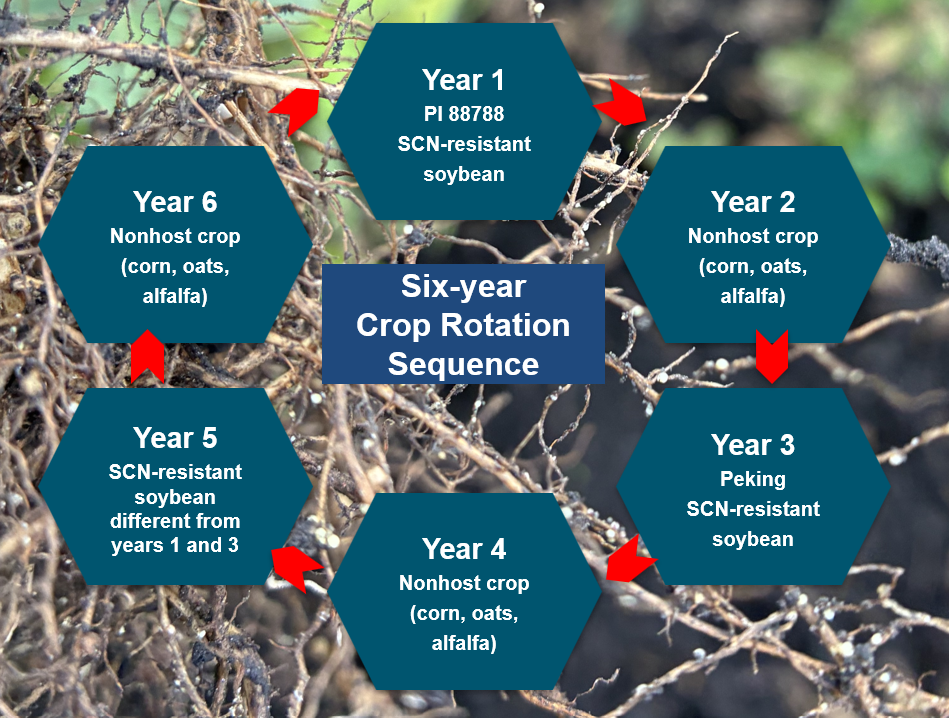
Figure 3. Example of a six-year crop rotation sequence for managing soybean cyst nematode (SCN). Adapted from The SCN Coalition, Soybean Cyst Nematode Management Guide, p. 20.
Sample this fall or very early next spring
Use a soil probe to collect 15-20 cores, 6-8 inches deep, from a reasonably uniform area of no more than 10-20 acres. Walk a zigzag or W pattern, combine the cores in a clean bucket, mix thoroughly, and place about two cups of soil into a labeled plastic bag. Keep the sample cool and out of direct sunlight and send it to the laboratory within a few days. Sample areas with poor yields or distinct soil conditions separately. Fall sampling after soybean harvest is preferred, but early spring sampling before planting is also useful when soils can be sampled.
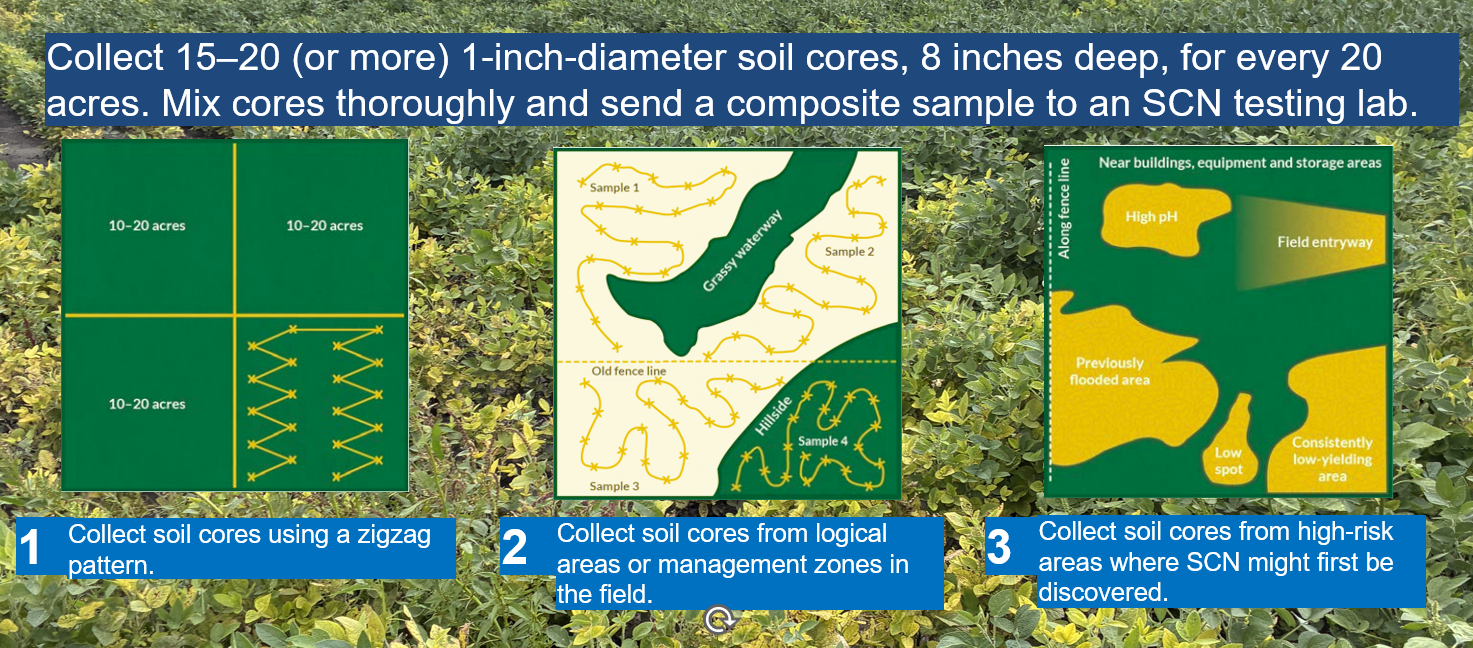
Figure 4. Three approaches to soil sampling for soybean cyst nematode (SCN): (1) collecting soil cores in a zigzag pattern, (2) sampling by management zones, and (3) targeting high-risk areas where SCN is more likely to be detected. Collect 15–20 soil cores, approximately 8 inches deep, for every 20 acres. Adapted from The SCN Coalition, Scouting and Soil Testing for Soybean Cyst Nematode (2021).
Minnesota growers can submit soil samples for SCN testing to the University of Minnesota Southern Research and Outreach Center Nematology Laboratory in Waseca, where Dr. Senyu Chen’s team conducts SCN research and diagnostic testing; AGVISE Laboratories in Benson, Minnesota, which provides SCN egg counts and interpretation; or Minnesota Valley Testing Laboratories (MVTL), which offers SCN screening. Farmers should confirm submission forms, testing fees, and shipping instructions directly with each laboratory before sending samples. Other qualified nematology laboratories may also be available.
Knowing your SCN numbers is one of the most practical steps you can take to protect soybean yield and profitability. Do not wait for visible symptoms. Test your fields, understand your results, and use that information to make informed management decisions for the next growing season. If you have questions or need assistance, contact your local University of Minnesota Extension educator, crop consultant, or Sergio Cabello-Leiva at the Minnesota Soybean Research & Promotion Council by emailing scabelloleiva@agmgmtsolutions.com.
Research and Testing Resources
1. University of Minnesota Extension. Know Your SCN Numbers: Free Fall Sampling Program Available. (2023). https://blog-crop-news.extension.umn.edu/2023/09/know-your-scn-numbers-free-fall.html
2. The SCN Coalition. Soybean Cyst Nematode Management Guide. https://www.thescncoalition.com/
3. The SCN Coalition. SCN Profit Checker. https://www.thescncoalition.com/profitchecker/calculator/
4. The SCN Coalition. Scouting and Soil Testing for Soybean Cyst Nematode. (2021). https://www.thescncoalition.com/wp-content/uploads/2021/12/Scouting-and-Soil-Testing-for-SCN-Resource.pdf
5. University of Minnesota, Southern Research and Outreach Center (SROC). Plant Pathology and Nematode Research and Testing. https://sroc.cfans.umn.edu/research/plant-pathology
6. AGVISE Laboratories. Sampling Fields for Soybean Cyst Nematode (SCN). https://www.agvise.com/sampling-fields-for-scn/
7. Minnesota Valley Testing Laboratories (MVTL). Soybean Cyst Nematode Screening. https://mvtl.com/testing-services/agriculture/soybean-cyst-nematode-screening/