Best of the Best highlights hottest topics in soybean research
Best of the Best highlights hottest topics in soybean research
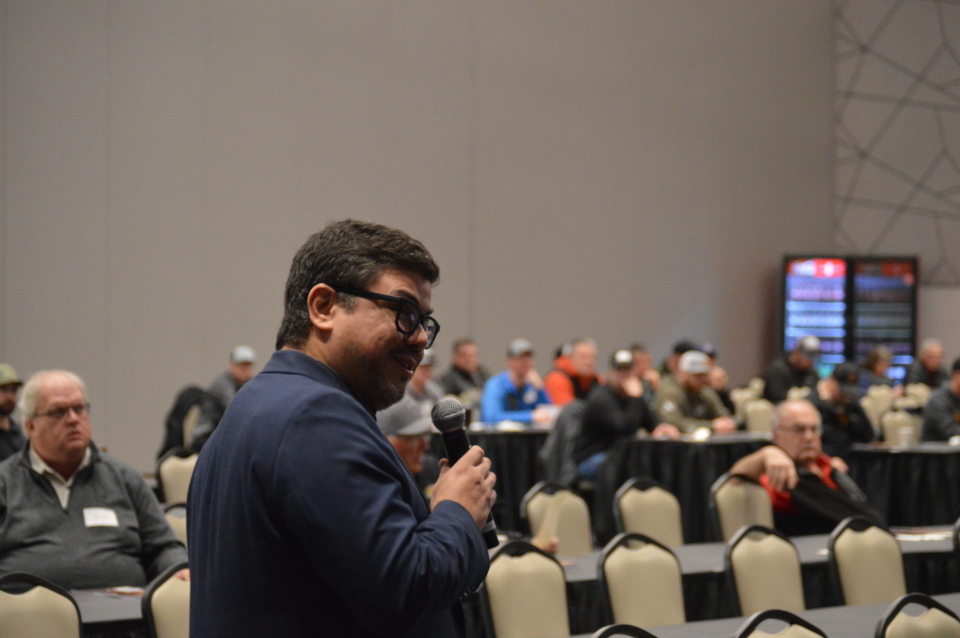
Bringing together the latest research in soybean and wheat production, the University of Minnesota Extension and North Dakota State University teamed up to host the annual Best of the Best in Wheat and Soybean Research Feb. 4 in Grand Forks and Feb. 5 in Moorhead. Sponsored by the Minnesota Soybean Research & Promotion Council in conjunction with the Minnesota Wheat Research & Promotion Council, Minnesota Association of Wheat Growers, North Dakota Soybean Council, North Dakota Grain Growers and North Dakota Wheat Commission, the program featured research highlights ranging from nitrogen management, compaction, biologicals, drainage and more, plus hands-on demonstrations from both NDSU and UMN researchers.
“Farmers come to Best of the Best so they can get applied research information that they can use on their farming operation,” said MSR&PC Research Director Sergio Cabello Leiva. “There was an amazing turnout, which is nice to see because it shows that farmers here in northern Minnesota care about research. They were very engaged, asked a lot of questions, and showed up in big numbers eager to learn.”
At a time when producers are facing challenging markets and high input cost, many researchers focused their presentations on how farmers can get thei best return on their investment. Both Seth Naeve, UMN extension soybean agronomist, and Lindsay Pease, UMN extension specialist, touched on their research with biological treatments and other crop inputs and whether or not they pay off.
“The farmers have moved away from a growth mindset to a survival mindset,” Naeve said. “We have to be more strategic in how we’re purchasing our inputs, and we have to prioritize the performance of those things in order to get the most out of them.”
On inputs, Naeve recommended growers should be skeptical of biologicals. The data from the research he has done in collaboration with the North Central Soybean Research Program showed there was statistically no significant yield increase.
“I knew in my mind that we were going to have products that would work in some locations and not others, but I was shocked to find out that nothing was working anywhere,” Naeve said. “What we found was, best-case scenario, we got a three-bushel an acre increase 25% of the time.”
Pease also highlighted her research on drainage and how drain tile can provide a more long-term ROI. On their drainage plot at the Northwest Outreach Center in Crookston, Pease found a four-bushel an acre increase on their soybean crop in 2020, which was coming off a wet year, on a tiled plot over their non-drained plot. However, on following years that were dry, there was significant difference.
“But I definitely also wanted to point out that we saw one to two weeks of less moisture stress, which especially on crops like soybeans is going to be really important to get those soybeans off to a good start,” Pease said. “Overall, the payback period is going to be over the lifetime of the project, as opposed to maybe one or two growing seasons, so it’s important to keep that in perspective.”
The ROI conversation was a hot topic throughout the Best of the Best program and other winter meetings this year, but Cabello Levia says it’s what farmers are most interested in at the moment.
“We’ve seen a lot of focus on applying the right amount of inputs and targeting the biggest margin for your crop,” he said. “Farmers are trying to pick the right technologies, the right practices that would benefit their operation, and at the end of the day their yield and their return on investment.”