

Summary Content
This checkoff-supported project’s primary purpose was to provide experimental learning opportunities to students both those in class, and those conducting the field work. While this grant focused on educating students on the uses of the Normalized Difference Vegetation Index (NDVI), all aspects of the soybean production cycle were fair game when it came to providing hands-on learning opportunities to students.
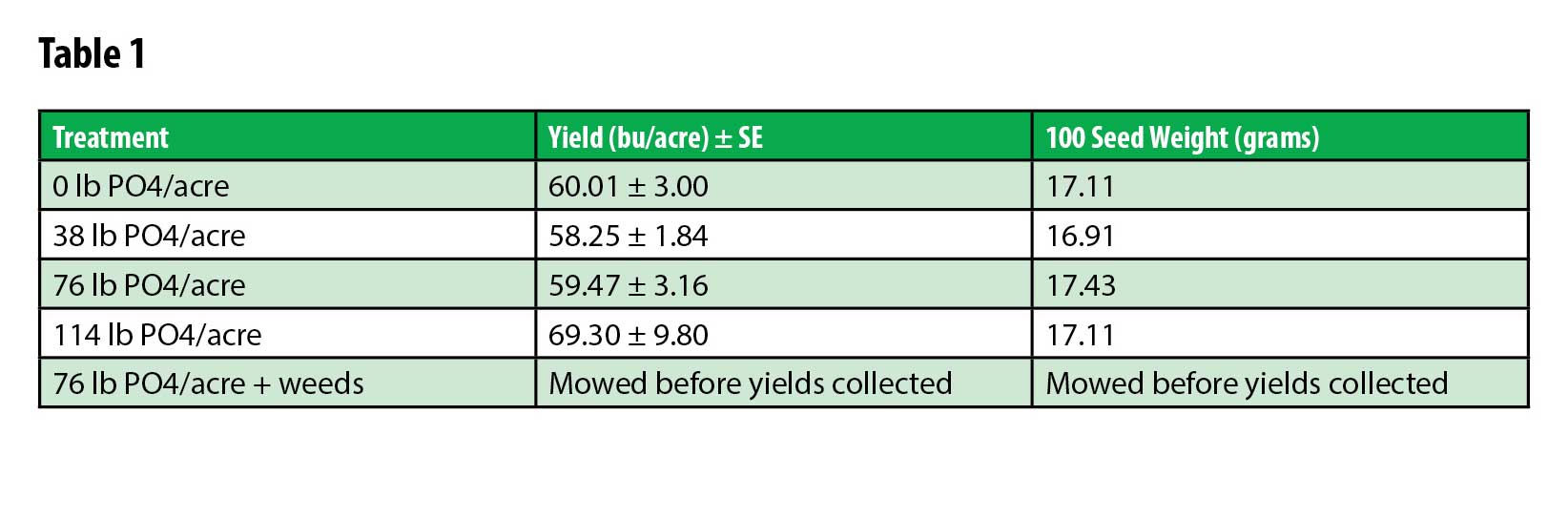
Our experiment looked at how altering the levels of added PO4, in PO4 deficient soil, impacted our weekly NDVI values as well as yield in soybean plots. Several PO4 rates were used (Table 1). In short the NDVI is a metric that ranges in value from 0 to 1 with values closer to 1, indicating healthy dense vegetation and those closer to 0 indicate little to no vegetation and/or a lack of photosynthesis. NDVI is calculated with machinery that measures red light (which humans can see) and infrared light (which humans cannot).
NDVI sensing was first developed in the 1970s, but only commercialized for agricultural use in the 2010s and allows for in-season management of N in a variety of crops. There is a variety of products, equipment, and services revolving around the use of NDVI currently on the market and more are being developed every day. As such, it appears NDVI, or a NDVI like metric (which uses other wavelengths of light) to get information about the crop is an approach to farming that is here to stay, and it is important our future ag workers understand its advantages and disadvantages.

Findings
Overall this project was a success and SMSU’s ag programs are grateful for the continuing support of MSR&PC. While no single fertility treatment outperformed any other single treatment in terms of yield (Table 1), the plots were primarily used as a staging area to teach future ag professionals some of the finer points of soybean production. We also found that NDVI values changed throughout the season and our only statistical difference was due to the inclusion of a weedy soybean treatment (Figure 1), highlighting the need to ground truth any remotely collected NDVI data. The results of these plots were communicated in person, at the plot to 130 non-student individuals, and 83 students at SMSU in the 2024-2025 academic year so far, for a total of 213 individuals. These numbers also include some SMSU courses such as: AGRO 132 Principles of Crop Production, AGRO 341 Principles of Pest Management.