
Sudden Death Syndrome in soybeans: A bigger risk in rainy 2025
Sudden Death Syndrome in soybeans: A bigger risk in rainy 2025
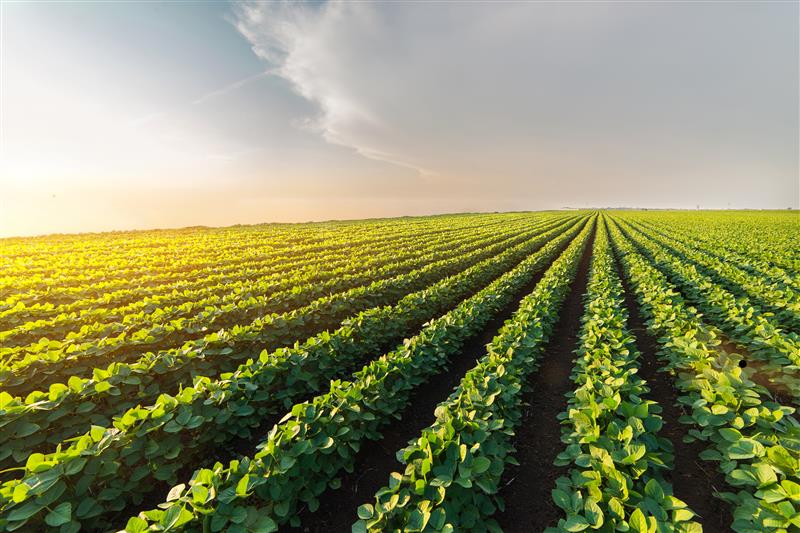
Sudden death syndrome (SDS) is a significant soybean disease in the U.S. that can reduce yields by up to 50% during severe outbreaks. In Minnesota, the disease is becoming more common, and this year’s unusually wet and rainy conditions are creating an ideal environment for SDS to spread. Heavy rainfall in July and August has been well above average across much of Minnesota; combined with warm weather, it offers optimal conditioans for the disease. SDS also tends to be more severe in fields with high soybean cyst nematode (SCN) pressure and in areas with compacted, saturated soils.
The pathogen
The fungus responsible for SDS is Fusarium virguliforme. It is soil-borne and can survive the winter in soybean and corn residue. Infection risk increases when soil is cool, wet and compacted, conditions often present with early planting. The fungus remains in the roots as the plants continue to grow, but during vegetative or early reproductive stages it produces toxins that move upward in the plant, leading to foliar symptoms.
Symptoms SDS symptoms usually appear in late July or August. The first signs are yellowing and browning between the veins of the leaves (Figure 1).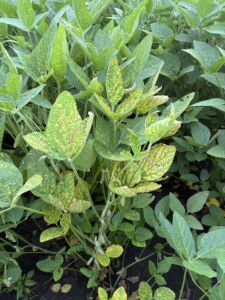
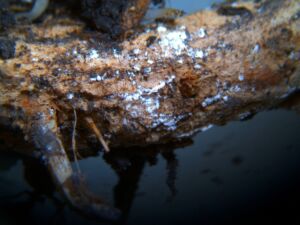
As the disease progresses, leaflets drop while petioles remain attached to the plant. In the roots, rot is visible, accompanied by a white to blue fungal mold (Figure 2).
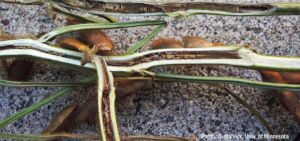
Brown Stem Rot symptoms
It is important to distinguish SDS from Brown Stem Rot (BSR) (Cadophora gregata), another soil-borne pathogen that causes similar leaf symptoms in soybeans. Splitting the stem helps: in brown stem rot, the inside of the stem shows brown rot tissue (Figure 3), whereas SDS does not. In some cases, both diseases can coexist, leading to a combined control strategy.
What steps can we take to control and prevent SDS?
Managing soil-borne diseases like SDS is challenging, but several tools can help reduce or control the pathogen.
- Crop rotation is an important tool to decrease disease pressure.
- Plant early but avoid planting when the soil temperature is below 50°F or conditions are wet, as this can promote early SDS infection.
- If SDS is present in a field, use high-yielding, resistant soybean varieties and rotate varieties over time.
- Use high-quality seed with good germination and vigorous, fast emergence to reduce the risk of early infection.
- Fungicide seed treatments like pydiflumetofen, adepidyn and fluopyram offer effective protection against SDS. Keep in mind that there are currently no successful foliar fungicide options for this disease.
- Manage soil compaction by reducing machinery traffic and adopting minimum tillage to enhance water infiltration. Non-host cover crops with strong taproots, such as brassicas, can also help reduce compaction and disease pressure.
The most important step in a year like 2025 is scouting. Detecting where symptoms appear in late July and August helps farmers make informed choices about resistant varieties, seed treatments and rotations in upcoming seasons. Reach out to your local Extension agent, agricultural professional or the Minnesota Soybean Research & Promotion Council if you have questions or notice unusual symptoms in your crops.
Sergio Cabello-Leiva, PhD
Director of Research, MSR&PC
Soil Scientist