
MSGA talks ag economy, domestic opportunities with Gov. Walz, MDA
MSGA talks ag economy, domestic opportunities with Gov. Walz, MDA

Matt Purfeerst has traveled a long way – figuratively, if not literally – since a stint a dozen years ago interning as an ambassador with Minnesota Soybean. Yet, through local advocacy, hosting trade teams and several rounds of media interviews, the Faribault farmer, husband and father of two children continues serving as an ambassador for the organization.
“I guess I never really graduated from the program,” Purfeerst said with a chuckle. “It all comes down to promoting our industry and our farmers.”
Purfeerst, the Rice County director with the Minnesota Soybean Growers Association (MSGA) since 2023, has been a stalwart advocate for his industry colleagues during the 2025 harvest. In a matter of weeks, he and his dad, Jim, hosted a Korean trade team; talked farm policy with Sen. Amy Klobuchar and visited with CBS News and the Guardian on his farm. On Oct. 15, during a hard-earned respite from harvest after receiving nearly an inch of rain the day prior, the Purfeerst family welcomed Gov. Tim Walz and the Minnesota Department of Agriculture to their family farm to discuss ongoing challenges and future openings within the farm economy. MSGA Executive Director Joe Smentek also attended to discuss how state-level policies can play a role in improving a stagnant farm economy.
“Our farmers are truly leading the way in highlighting the federal and state issues that are limiting their ability to thrive,” Smentek said. “We all wish we were sharing better news, but MSGA’s message is being delivered from here at home to media literally across the world: Washington, D.C., Europe, Asia, Australia and markets in between. MSGA are looked upon as a dependable source on what’s currently happening in the farm economy.”
Since 1962, MSGA has put policies above partisan politics, working with both parties to fight for farmers to develop markets, ease regulatory and tax burdens and promote new uses. Any legislator, no matter their political stripe, who is interested in learning more about agriculture is treated like a welcome guest on the Purfeersts’ farm.
“We’re having an open discussion on what solutions might be out there and what we’re seeing,” Matt Purfeerst said. “Anytime we get a chance to promote agriculture, we’re going to invite anybody down, no matter what (policitical) side you lie on. It takes a whole team effort.”
‘Getting crunched’
During an hour visit to the Purfeests’ sixth-generation grain and cattle operation, which has produced a crop every year since 1857 – “This farm’s been here since before Minnesota (was a state),” Gov. Walz pointed out – the governor visited with Matt, Jim and Matt’s brother, Mark, and assorted family members to learn more how tariffs, low commodity prices and stubbornly high input costs and interests rates are creating a crisis in farm country, not to mention health care prices for farm families.
“We’ve seen a 20% drop in commodity prices without our input costs going down,” said Jim Purfeerst, a Rice County commissioner. “We’re getting crunched from both sides.”
Gov. Walz also added that calls seeking financial and mental health assistance through MDA’s Minnesota Farm & Rural Helpline (Phone: 833-600-2670; Text: FARMSTRESS to 898211; or Email: farmstress@state.mn.us) are the highest on record.
“These folks are in a tough time,” he said.
Tariffs are adding fuel to the economic calamity for many farmers. Minnesota was the nation’s fourth-largest soybean producer in 2024 – the state’s over 25,000 producers harvested nearly 330 million bushels last year – and depends on exports to boost profitability. The ongoing trade war with China has caused a drop in exports; typically, one in four rows of Minnesota soybeans is sent to China. In total, Minnesota soy farmers export over $2 billion each year, accounting for about 25% of all the state’s ag exports.
“Politicians didn’t create these markets; producers did,” said Walz, citing the U.S. soybean industry’s four-decade long investment in growing markets in China.
But so far this marketing year, China has yet to make a single purchase of U.S. soybeans, and the state’s overall exports have dipped by nearly 20%.
“This is an important industry for all of us. It’s a core of who we are as Americans and as Minnesotans. We need to find some solutions,” Gov. Walz said. “We’re producing a lot of beans – we’ve just got to get them to where they need to go.”
The governor and the Purfeersts also discussed the necessity of federal assistance once the government shutdown ends and urged federal lawmakers to work together to pass a relief package, along with a “skinny Farm Bill.”
“Our farmers will tell you they don’t want it, but I’m supportive. They need to get the resources now,” Walz said. “This is not the solution, it is a Band-Aid, but when you need a Band-Aid, use the Band-Aid.”
‘Holding out hope’
The governor and Minnesota Soybean agreed that there are myriad opportunities here at home and internationally to diversify demand. Walz said his administration is dedicated to working with lawmakers and private industry to position Minnesota as a leader in the sustainable aviation fuel (SAF) and biofuels marketplaces.
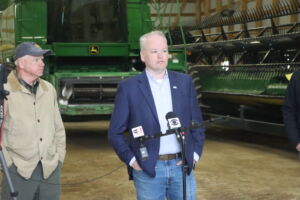
MSGA Executive Director Joe Smentek speaks on the need for growing domestic markets during a press conference alongside Tim Walz (left) Oct. 15, 2025.
“I’m 100 percent behind pushing SAF as hard as I can,” he said.
MSGA and its partners at the Minnesota Soybean Research & Promotion Council continue to promote and educate on the over 1,000 commercially available soy-based products, including sneakers, firefighting foam, road sealants, paints and roof rejuvenators.
“Joe (Smentek) has been wanting me to buy soy tires,” said Gov. Walz, who indeed has a set of Goodyear’s soy-based tires on one of his official vehicles.
Smentek said that while federal policies are influencing farmers’ bottom lines, the Minnesota Legislature and Walz administration can also play a more active role in the upcoming legislative session toward improving the outlook for Minnesota agriculture, the state’s second-largest industry, by supporting animal agriculture producers and easing truck-weight restrictions.
“We could talk for hours and hours about the issues affecting farmers,” he said. “Every administration, we have challenges. … There’s always something to work on, that’s why we’re a nonpartisan organization. We appreciate the spotlight these issues are getting.”
Minnesota Soybean is focused on promoting growing new markets in the months and year ahead while urging an immediate solution with Chinese trade partners. Smentek recently visited Taiwan and will join MSGA President Darin Johnson and the Walz administration in November on a trade mission to Europe, which is the second-largest market for U.S. whole soybeans and soybean meal.
“We have a better product than South American soybeans,” Smentek said. “There’s a desire to get back to normal on both sides. … We still are holding out hope. Other markets, we continue to work on. We need everything.”