
A Minnesota-first mindset: MSGA promotes MN ag during EU trade mission
A Minnesota-first mindset: MSGA promotes MN ag during EU trade mission
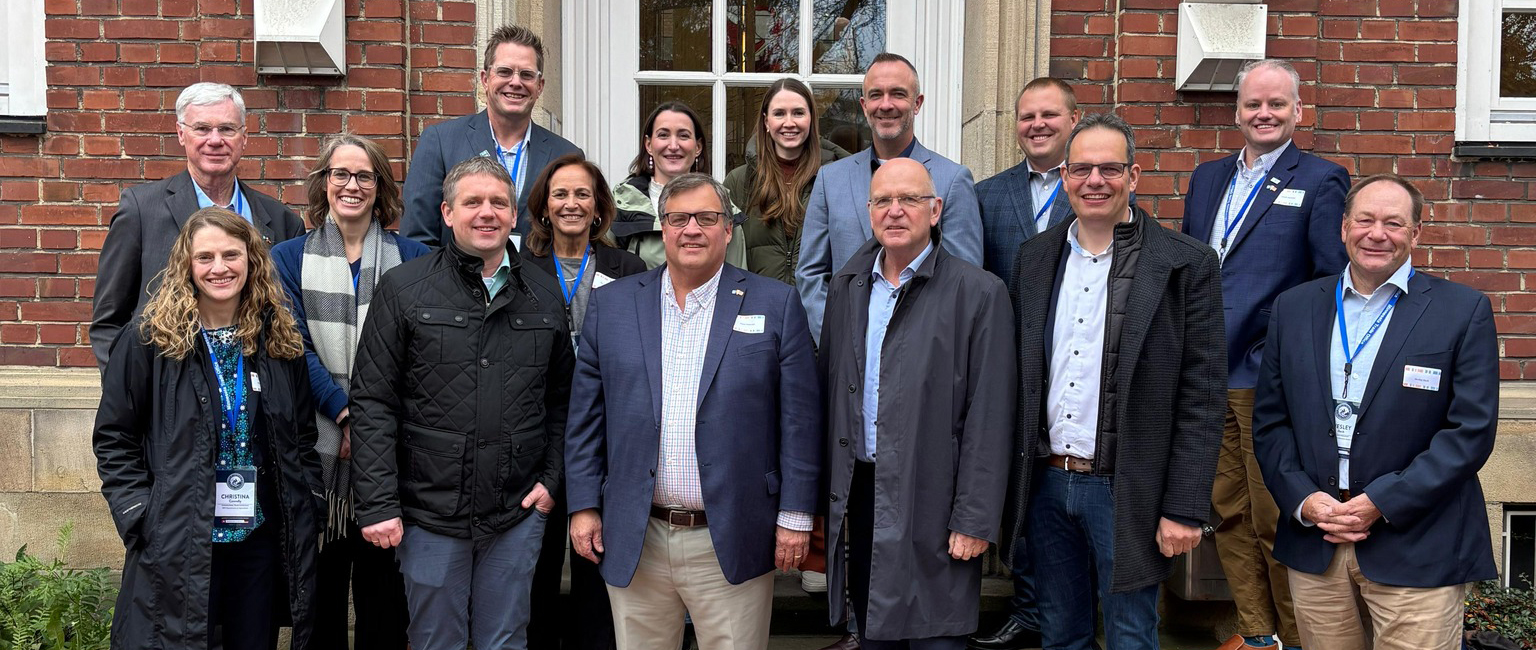
Leaders from the Minnesota Soybean Growers Association (MSGA) traveled abroad in November 2025 to meet with industry and trade partners in Switzerland and Germany. The European Union (EU) trade mission was organized by Minnesota Gov. Tim Walz and focused on promoting Minnesota industries and business along four different tracts, including agriculture, energy, medical and education.
The EU remains a strong trade partner with the United States. According to the U.S. Soybean Export Council (USSEC), the EU represents about 11% of all U.S. whole soybean and soybean meal imports. Of the sixty plus people on the trade mission, there were nine on the ag tract, including the Minnesota Department of Ag Commissioner Thom Peterson and MSGA President Darin Johnson and Executive Director Joe Smentek. The small group allowed for more intimate discussions and better networking opportunities among the cohort.
“The nice thing about these trips is you’re sitting in the airport with the governor, so there was a lot of time to chat with him, as well as the commissioner and deputy commissioner of agriculture, about the stuff going on in Minnesota,” Smentek said. “Having that small group really helped strengthen the bonds with groups we don’t normally get to talk to and deepen those connections to strengthen agriculture in Minnesota.”
The trade mission began in Zurich, the largest city in Switzerland and a global center for banking and finance, where they met with Jeff Rowe, the CEO of Swiss-based Syngenta. Johnson said the visit to Syngenta, a company familiar to most U.S. farmers, provided a unique perspective on how it operates in EU and the challenges Syngenta face.
“From a policy standpoint, they’re very similar to what our organization (MSGA) is dealing with now and into the future,” Johnson said. “As far as the environment goes, they’re on top of it because they have very strict rules that they have to follow on their farms.”
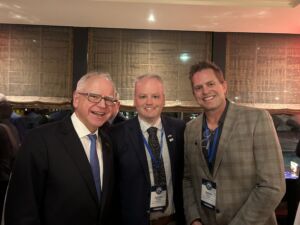
MSGA President Darin Johnson (right) and Exec. Director Joe Smentek (middle) visit with Gov. Walz during a trade mission to Europe in November 2025.
Those strict environmental regulations in the EU are making it difficult for the smaller farms, especially in Germany, to adapt to those changes. Conversely, the much larger farms in the U.S. have already implemented and adapted conservation practices that meet the regulatory needs of EU. Throughout the trade mission, the Minnesota delegation highlighted MDA’s voluntary Minnesota Agricultural Water Quality Certification Program (MAWQCP), which rewards growers for implementing healthy conservation practices.
“As Europe continues to put on more restrictions, it’s going to make it more difficult for them to meet their own demand,” Smentek said. “We in the U.S. have ways of meeting their demand and those environmental regulations, such as deforestation, so we’re sitting in a pretty good position to send them biofuels and grains as they stop producing them because of the regulations.”
Keeping it ‘real’
The trade group also had the opportunity to visit with fellow farmers representing the Westphalian Farmers Association, one of the main trade organizations in Germany that represents agriculture.
“We had a lot of great back-and-forth conversations about some of same issues we deal with in Minnesota, such as regulations on crop protection products and solar farms taking over highly productive land,” said Johnson, who’s enrolled in MAWQCP. “They’ve had some good years recently because of added demand with what’s happening in Ukraine, but they’re producing less because of restrictions.”
The group then met with representatives of a pair of companies who also conduct business in Minnesota. In Switzerland they met with Buhler, an international company that engineers and manufacturers food processing equipment and systems. The company operates in more than 140 countries and has a location in the Twin Cities. While In Germany, they also visited one of the facilities of Minnesota-based Cargill, where the discussion quickly led to the topic of tariffs.
“Tariffs have made it difficult for them to get products into the U.S., so there was definitely some frustration on that side of things, but we’ve historically had a good trade relationship with them in the past through the bilateral trade agreements,” said Johnson. “Overall, the conversation was pretty positive in the end, and they remain a very important trade partner with us.”
Just prior to the delegation’s arrival, the U.S. and Switzerland agreed to cut tariff rates from 39% – the highest rate of any European country – to 15%. As Minnesota Soybean seeks to grow the EU market and diversify exports beyond China, Johnson believes that these trade missions play an important role in strengthening customer relations and letting them know that our farmers are doing everything they can to provide them with quality product regardless of tariffs.
“It’s all about the relationship that we’ve made with them and being able to have a candid conversation about what we’re doing on our farm,” Johnson said. “It really, truly does show how confident we are in the crops we’re producing on our farms and in turn they can be more confident in making a purchase from us, knowing that they can put a face to the commodity.”
Johnson said he was pleased with the positive interactions between all the different tracts and the “Minnesota-first” agenda of the trip, including promoting one of the state’s most critical economic drivers: agriculture.
“It makes you feel good about Minnesota,” Johnson said. “There’s a lot of good people out there fighting the good fight to make the state better and build business and relationships. We were able to throw some of the politics aside, talk about agriculture and just be real.”
Included in the delegation was MDA International Trade Supervisor Christina Connelly, who replaced the retired Jeffrey Phillips. She was encouraged by the reception ag leaders received and the strong showing of unity delivered by state leaders, including MDA Commissioner Thom Petersen.
“People were so happy we were there,” Connelly said. “I think they were happy to see a state show up and deliver a message of, ‘We’re still here.’”
Minnesota Soybean continues to prioritize developing markets in 2026 and expects to participate in upcoming global trade missions alongside state and national partners, including USSEC, the United Soybean Board, American Soybean Association and WISHH.