
MSGA address numerous federal policy issues during D.C. Hill Visits
MSGA address numerous federal policy issues during D.C. Hill Visits
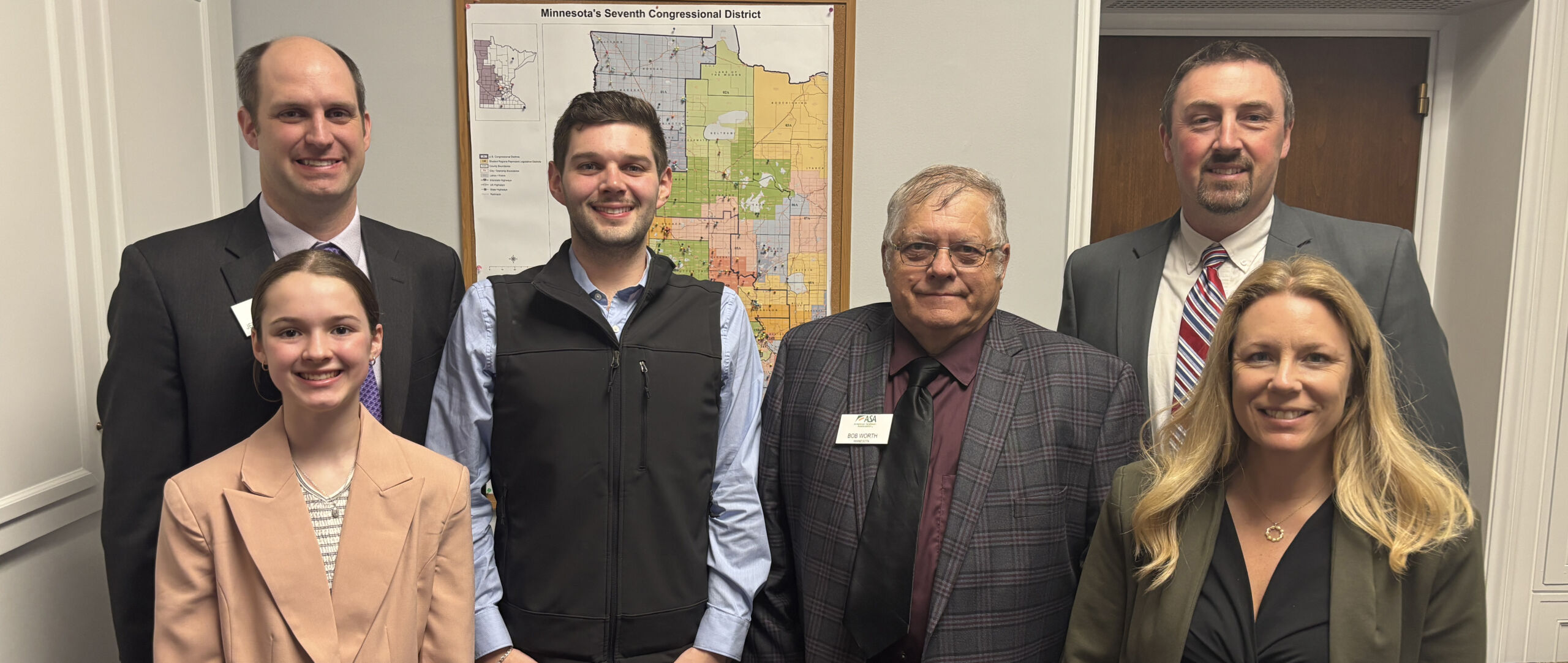
The Minnesota Soybean Growers Association had already prepared a plethora of federal policy priorities to share with the state’s congressional delegation in the weeks leading up to its March 2026 Hill Visits in Washington, D.C.
And that was before the Iran war threatened to increase fuel prices and further drive-up costs for fertilizer and other crop inputs, due to the blockage of the Strait of Hormuz. Prior to the war, fertilizer costs were already outpacing inflation, and soybean advocates are increasingly worried that the war will hurt an already battered farm economy.
“What’s happening in Iran over the past couple of weeks has exacerbated issues that we’re already struggling with,” said Wheaton farmer Jamie Beyer, who serves on the American Soybean Association’s Executive Committee. “Farmers are really seeing it from all sides – low commodity prices and higher input costs across the board.”
The conflict has also highlighted, once again, how geopolitics can affect producers in Minnesota.

Jeff Sorenson shows his daughter Avery a map of Rep. Michelle Fischbach’s district, which includes the Sorensons’ family farm in Redwood County.
“Everything is so interconnected,” said Redwood County farmer Jeff Sorenson.
Beyer was joined by three American Soybean Association directors – Adam Guetter, Jeff Sorenson and Bob Worth – along with Minnesota Soybean Growers Association Treasurer Rose Wendinger for ASA’s biannual Hill Visits and board meetings. Directors met with nearly all of Minnesota’s congressional delegation. The House was in recess, which meant directors mostly met with legislative aides, offering directors an opportunity to build connections with staff.
Over the course of a day on Capitol Hill, farmer leaders tackled a wide range of policy issues, including:
- Promoting trade, including preserving the U.S.-Mexico-Canada Agreement during its formal review this year.
- Supporting a comprehensive, meaningful Farm Bill that addresses ASA’s priorities.
- Finalizing strong Renewable Volume Obligations (RVOs) to build stronger markets for U.S. soybeans.
- The need for further financial support from Congress for growers.
- Pesticide labeling.
- Promoting the health benefits of soybean oil.
In over 20 years of attending Hill Visits, Worth can’t remember another time when the ag economy was facing so many headwinds. He explained to legislative aides how Minnesota lost about 1,400 farms in 2025, along with his fears for the younger generation of farmers.
“The profits just aren’t there right now, and that’s been the case for several years now,” he said. “That’s why there’s need for more assistance, because the (Farmer Bridge Assistance) program covered less than 40% of our losses.”
Sorenson, a fourth-generation family farmer, brought an example to underscore his passion for preserving his operation for the next generation: his 12-year-old daughter Avery, who accompanied her dad on a field trip to the Hill Visits on her first visit to the nation’s capital. Avery, who hopes to be a veterinarian or nurse when she grows up, watched her dad in action as he represented Minnesota farmers during meetings with Reps. Michelle Fischbach’s and Tom Emmer’s staff. The Sorensons also reconnected with Sen. Tina Smith, who visited Jeff and his wife, Kelli, on their farm in April 2025. The senator, who’s retiring this year, reiterated her support for passing a new Farm Bill and listened as Jeff Sorenson and Beyer explained how farming communities in Minnesota rely on agriculture for economic and cultural vitality.
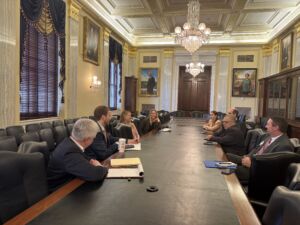
Minnesota farmers meet with Sen. Amy Klobuchar’s staff during a March 11, 2026, visit on Capitol Hill.
“People want to stay in small towns, and I think that’s a trend we’ve been seeing since the pandemic,” Beyer said, “Agriculture helps sustain our way of life.”
Sorenson said it was a thrill to show his eldest daughter around Washington, D.C. Avery only had one complaint.
“Too much walking!” she said. And Avery had a point – the team walked nearly four miles around the Capitol during the Hill Visit.
In the day’s final visit, grower leaders spent nearly 75 minutes in the Senate Ag Committee offices visiting with legislative staffers representing Sen. Amy Klobuchar. In a wide-ranging discussion, directors emphasized the “urgency of now” in improving the outlook for the nation’s half-million soybean farmers, from protecting market access to growing domestic uses of soybeans.
In every policy conservation, the topic eventually circled back to a single lingering question that drives at the heart of MSGA’s mission:
“How can we improve profitability?” Worth asked.
MSGA hopes to have more answers than questions when it returns in July to Washington, D.C., for ASA’s summer Hill Visits.
“We really need the long-term forecast to get better,” Sorenson said. “We have a Band-Aid now, but we need long-term solutions.”