
MSGA directors host Korean trade team
MSGA directors host Korean trade team
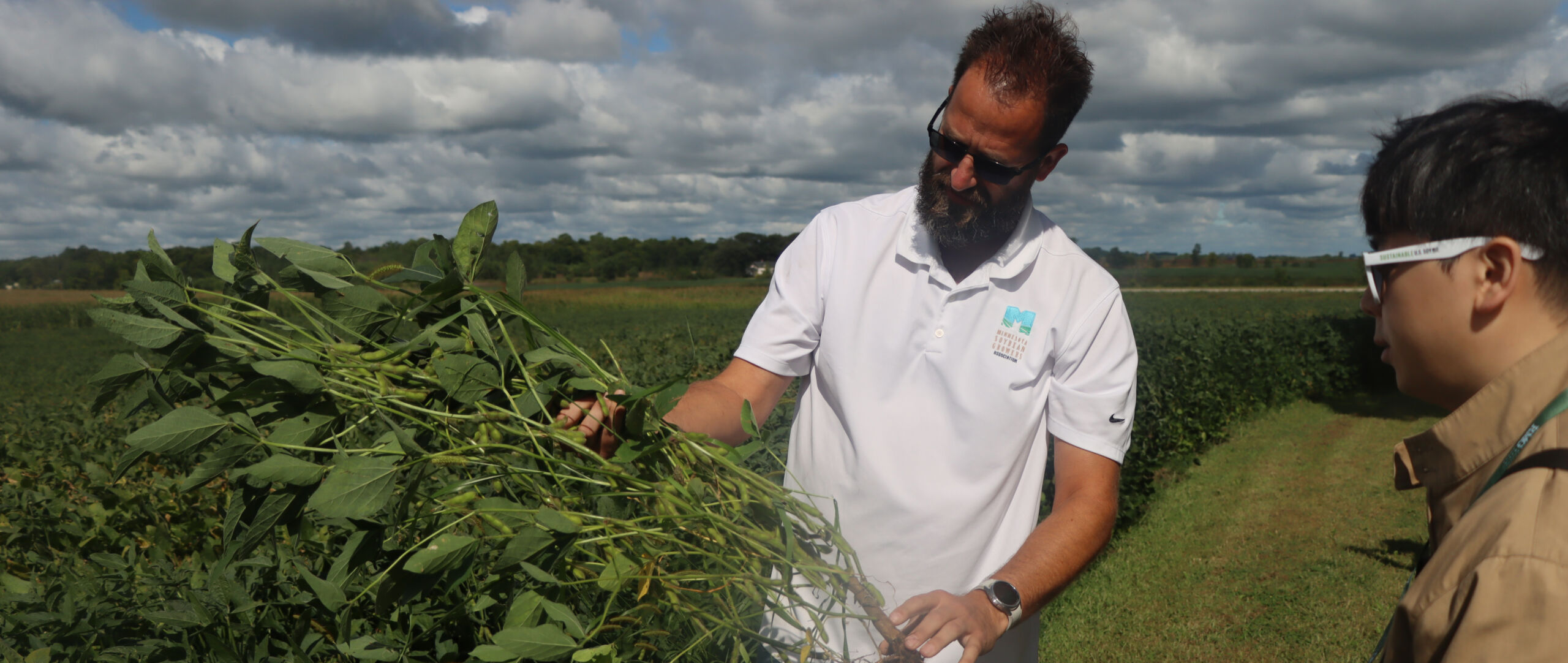
Throughout the 2025 growing season, trade – and, more specifically, expanding international markets – has been top of mind for the half-million soybean farmers across the U.S.
For Brownton grower Ryan Mackenthun and his peer to the east, Faribault farmer Matt Purfeerst, trade relationships begin with a smile, firm handshake and mutual respect, with the end goal of growing demand for U.S. soy. While trade uncertainty led China, the largest purchaser of U.S. soybeans, to largely sat on the sidelines on the eve of the 2025 harvest, Mackenthun and Purfeerst welcomed 10 buyers from South Korean’s crush and feed milling industries to their family farming operations.
“In general, they (South Korea) know the product of U.S. soy is high,” said Dr. Hyung Suk Lee, Korea Country Director with the U.S. Soybean Export Council (USSEC), which coordinated the tour with checkoff support from the Minnesota Soybean Research & Promotion Council.
Farming isn’t just an occupation for Mackenthun, it’s been his passion since he was 12 and first began driving the tractor and showing cattle and hogs. He hopes to one day pass his 2,200 acres of farmland onto his three children, including his oldest son, Jackson, who tagged along on a crisp August morning as his dad gave his guests a tour of his bin site.
“Farmers like me rely on trade,” Mackenthun, vice president of the Minnesota Soybean Growers Association (MSGA), told his guests. “Hopefully, it will make it easier for me to pass the farm onto the next generation.”
A member of the Korea Commodity Trade Team takes a look at Ryan Mackenthun’s high-quality soybeans.
During his two-hour tour, Mackenthun walked his new friends through his growing practices, including the cost benefits of sharing equipment; how seed treatments are effective pest management tools; technology’s impact on agriculture and why tariffs shied him away from planting more soybeans in 2025.
“As soybean farmers, we’re afraid of tariffs – it’s a complicated situation, but it’s hurting our profitability,” he said. “We value our partnerships with our trading partners, and the trust we’ve built over the years.”
With his bean field several weeks from maturation, Mackenthun gave buyers an up-close look at his 2025 soybean crop. While he was feeling optimistic about harvest, Mackenthun also explained how a wet growing season contributed to sudden death syndrome on his crop, along with the ways in which Minnesota cold winters and bin fan systems help keep his soybeans largely free of foreign material (well under 1 percent, he reported).
“Margins are very tight right now, so we have to be very diligent,” he said.
During marketing year 2023/24, Korea and its population of 51.5 million ranked 10th for U.S. whole soybean exports, second for U.S. food soybeans and sixth for U.S. soybean oil exports. Korea annually crushes about 1 million metric tons (MMT) of soybeans, 40% of which is usually purchased from the U.S. Typical soy foods include tofu, soy sauce and paste, soy milk and soybean sprouts. Soybean oil is a popular vegetable oil, second to palm oil. Soymeal is a major protein source for compound feeds, especially for swine and poultry.
Stepping on an American farm was quite the sight for Gim Jinuk, a manager in the purchasing division of Nonghyup Feed in Seoul. His first visit to America began with a stop in the nation’s capital before stopping through Minnesota.
“Everything is really big here,” he said, pointing to Mackenthun’s combine. “This is just a really good opportunity to see an American farm.”
Mackenthun hopped on the bus to take the trade team to his local elevator at United Farmers Cooperative in Brownton. His soybeans are typically loaded onto rail and sent to the Pacific Northwest, ultimately destined for Asia.
“This is where I get my grain to you,” Mackenthun said.
Mackenthun sent his new friends off with “Minnesoyta”-branded gifts, a parting handshake and a better grasp of life as a Minnesota family farmer.
“It was a great opportunity to share how the soybeans they import are grown right here on my farm,” he said.
‘Seeing is believing’
Matt Purfeerst is a sixth-generation soybean and corn farmer who represents Rice County on MSGA. He farms with his father, Jim, and brother, Mark.
This trio has hosted several trade teams, most recently in 2024, and this summer they hosted the Korea Commodity trade team. Following the group’s Mackenthun visit, they pulled into the Purfeerst farmyard on the morning of Aug. 26.
“I think the biggest thing is they’re here to learn, so a lot of it is just showing them how we do things, not trying to hide anything, but just trying to show them how we do it, why we do it,” Purfeerst said. “I think it’s just a lot of proving that we’re just trying to grow a good and sustainable crop and to tell them how we appreciate their business, and hopefully they keep buying from us.”

MSGA Director Matt Purfeerst explains his production practices during a meeting with the Korea Commodity Trade Team Aug. 26, 2025, at his Faribault farm.
Rolling into the yard, the various buyers stepped off the bus, handing their business cards to the Purfeersts as they gathered around to hear about their operation.
Through a translator, the Purfeersts explained how they work to implement new sustainable practices, including no-till, cover crops and keeping with a corn and soybean rotation.
“I thought the most engaging question was about the sustainability portion of our farm,” Purfeerst said. “We were talking about cover crops and reduced tillage, and they just had some interesting conversations about it. The first question was, ‘What kind of yield response have you’ve seen?’ – which I thought was a very interesting first question to ask out of the gate.”
The group based most of its questions around yield per acre and sustainability practices adopted by the Purfeersts and how it affects their operation and bottom line.
“Seeing is believing,” Hyung Suk Lee said. “They want to know how the U.S. soybeans are being produced in the state in a sustainable way, and how we can trust the quality and about the supply chain in the U.S. soy industry so that they can be more competent about the quality and timely delivery from the U.S. soy.”
The trade team experienced the large farm equipment by standing next to it, posing for photos and climbing into the cab to peer out below.
The tour continued with a stop at a soybean field about a mile down the road from the farmyard, where they tasted the soybeans right out of the field and held the pods. They took photos and notes as the translator shared information about their practices and what it takes to grow soybeans in Minnesota.
“I think it’s great to host these trade teams,” Purfeerst said. “For us, it just gets your name out there, helps promote U.S. soybeans and even Minnesota soybeans. We’re happy to do it and appreciate everyone that’s involved in getting them here.”
The final stop on the Purfeerst farm tour for the Korean trade team took place at the operation’s grain bin site.
Just down the road, they stepped onto the gravel lot and shot their necks back to look at the top of the grain bins. They learned how soybeans are not dried in Minnesota, but they have the equipment to do so. The Purfeersts shared that they have empty bins currently with harvest approaching September and October.
Some of the trade team members climbed into the empty bin to see and feel just how big of a space it is for the product. For both buyers and their hosts, memories were made.
“I just want the Korean buyers to understand more about the dedication and effort of U.S. soy farmers for producing good soybeans,” Lee said, “so that whenever they see U.S. soybeans and soybean meal and other soy products, they can remember the effort from the U.S. soybean farmers.”