Faribault farm family makes fast friends with Taiwanese buyers
Faribault farm family makes fast friends with Taiwanese buyers
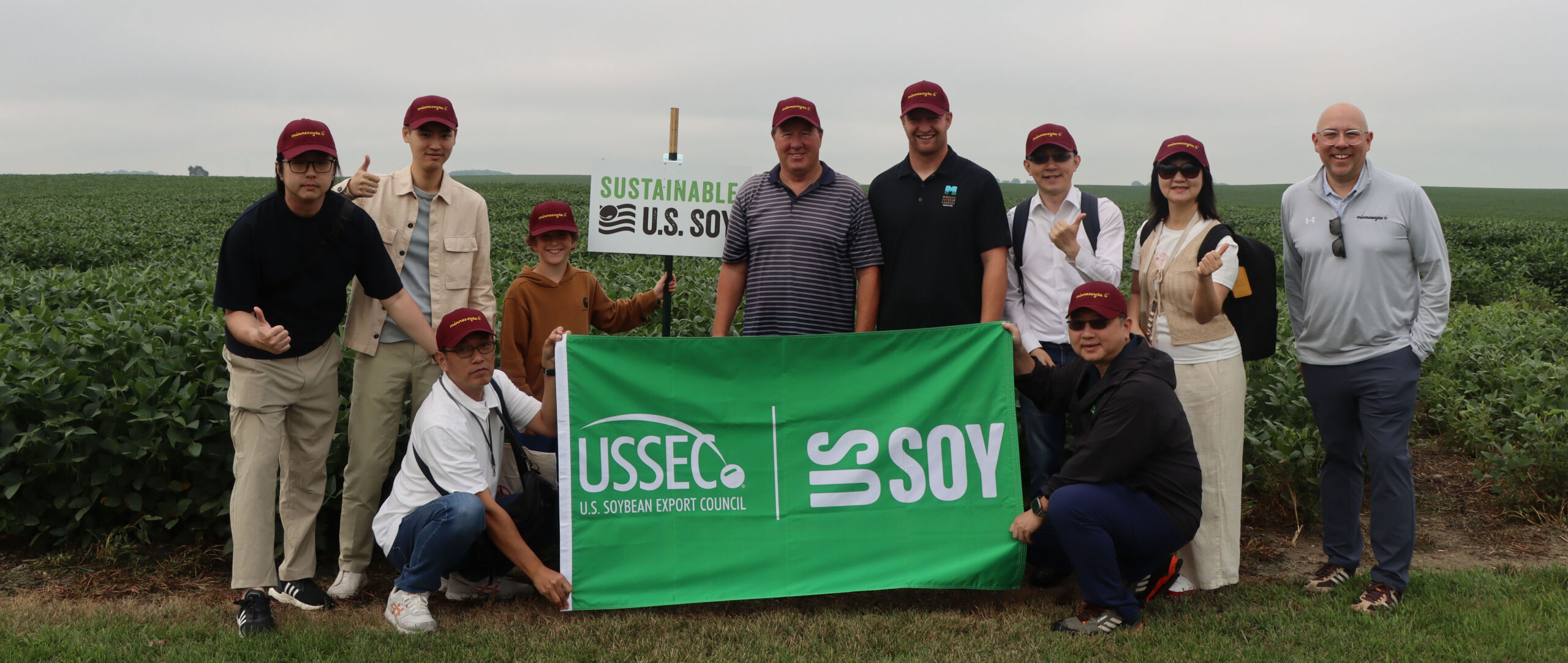
Faribault farmer Matt Purfeerst isn’t just asked to host international trade teams because his family farm sits a mere hour south of the Minneapolis-St. Paul International Airport. His farm is also an ideal location for international delegations because Matt and his dad, Jim, are welcoming, affable and eager to share their story and explain how their family has raised high-quality, sustainable crops since the 1850s.
“I probably learn more from them than they do from me,” said Purfeerst, a fifth-generation farmer who represents Rice County on the Minnesota Soybean Growers Association (MSGA). “And the more we can export, the better off we all are. It helps them, too, because they want to import our beans. It’s a win-win.”
On Aug. 10, 2026, the Purfeersts took time away from what had become an increasingly busy stretch prior to harvest to welcome a team of agricultural industry leaders from Taiwan.
“You’ve got to show your buyers what we’re producing,” Jim said.
After welcoming the group into his farm shop, Matt Purfeerst walked his guests through the pace of the growing season. But he advised against stepping into his nearby soybean field on a muggy morning.
“Walking in a bean field isn’t fun — you’ll be soaking wet,” Purfeerst said, before joking, “You guys want to go in?”
Preferring U.S. Soy
The Taiwan buyers had made their way to Minnesota following a visit to Soy Connext, the industry’s premier trade event, in Chicago. The delegation was accompanied by staff from the U.S. Soybean Export Council, which hosts Soy Connext, and the Minnesota Department of Agriculture. As part of efforts to build international markets, the Minnesota Soybean Research & Promotion Council invests checkoff resources towards supporting MDA’s Taiwan trade office.

Matt Purfeerst (far right) visits with Taiwanese soybean purchasers during a visit to his Faribault family farm Aug. 10, 2026.
“These trade visits are such a good opportunity for Minnesota farmers to connect with buyers and give an up-close look at how they’re raising the crops that make their way to Taiwan,” said Irene Tsai, managing director of MDA’s Taiwan office. “Without the support of (MSR&PC), we wouldn’t be able to bring (the group) to Taiwan.”
The group represented leaders from across Taiwan’s crushing and feed industries, including Lee Shou-Hao, a commodity trader at TTET Union Corporation, Taiwan’s largest soybean crusher.
Located in southern Taiwan, TTET has an annual crushing capacity of 1.5 million tons. Lee Shou-Hao was returning to Minnesota: In 2018, he visited the state when the Taiwan Vegetable Oil Manufacturers Association signed a letter of intent at the Governor’s Mansion alongside MSR&PC CEO Tom Slunecka to purchase $1.56 billion worth of Minnesota and Iowa soybeans over a two-year period.
“U.S. soybeans are preferable because of their higher quality and lighter color,” Lee Shou Hao said, adding, “It’s a very beautiful field here.”
U.S. soybeans are one of Taiwan’s top agricultural imports: The country imports nearly $700 million in U.S. soy, equating to about 18% of U.S.’s total ag exports to Taiwan. Minnesota soybeans are typically shipped by bulk vessels and containers via the Pacific Northwest.
On a per-capita basis, Taiwan is the largest consumer of U.S. food products. Taiwan imports soy for both human and animal (mostly hogs and poultry) consumption, and there’s an increased demand in using soybean oil for biofuels, in addition to cooking oil. Taiwan’s imports of U.S. soybeans could grow by more than 50-60% in the years ahead.
Over the years, Minnesota Legislature has also passed numerous resolutions of support to encourage trade growth between the two countries, often referred to as “sister states.”
“It’s a very vibrant country and we have a really great relationship with the people of Taiwan,” said MSGA Executive Director Joe Smentek, who toured Taiwan in 2025 during a USDA trade mission. “It continues to be one of our top developing markets.”
‘What it’s all about’
The Purfeersts rotate about 4,000 acres of corn and soybeans. They have one full-time employee and also use seasonal help during the growing season. Workforce issues are a constant struggle across agriculture, Jim Purfeerst explained to his international guests.
“Good labor is hard to find around here, and we’re no different,” he said.
The Purfeersts are adapting to those challenges, thanks to new technology. Matt Purfeerst showed the delegation the farm’s new 100% autonomous and solar-powered, AI-driven sprayer – the first of its kind to be used in Minnesota. The sprayer helps reduce the Purfeersts herbicide use by over 90% and minimizes soil impaction.
“You just leave it, and it goes between the rows,” Matt said.
Jim Purfeerst said the new technology has caught the attention of his neighbors.
“Yeah, they’re all asking about it,” he said. “Of course, equipment costs are going up, but we’re recommending it because of all the benefits, from less manpower to how accurate it is.”
The group departed with gifts, including “Minnesoyta” hats, before departing for a tour of CHS’ Grain Terminal in Savage along the Minnesota River — but not before an invitation from Jim.
“If you guys want to come back and run the combine during harvest, you’re welcome to,” he said.
The Taiwan officials later capped their day by meeting with directors from MSR&PC at a Minnesota Twins baseball game.
“This is what it’s all about — developing relationships, both on and off the farm, in Minnesota and Taiwan,” Smentek said.