Petersen: Stewardship strengthens Minnesota agriculture
Petersen: Stewardship strengthens Minnesota agriculture

This column by MDA Commissioner Thom Petersen first ran in the January-February 2026 issue of Soybean Business. Click here to read the digital issue.
For a decade, the Minnesota Agricultural Water Quality Certification Program (MAWQCP) has demonstrated what happens when experience and sound science move in the same direction. Beginning as a farmer‑driven pilot program emphasizing practical solutions, the voluntary program has steadily expanded over the years, reflecting producers’ growing interest in conservation.
Having reached the official 10‑year mark of the statewide rollout of the program, over 1,700 producers now manage more than 1.23 million certified acres. Each year, those acres keep nearly 167,000 tons of soil where it belongs while preventing over 59,000 tons of sediment and 75,000 pounds of phosphorus from reaching Minnesota waters. This is measurable progress driven by farmers who take stewardship seriously and understand its role in long‑term agricultural strength.
Soybean producers have been essential to this progress. Your adoption of conservation‑minded strategies — including nutrient management, reduced tillage, and improvements like cover crops — shows how practical approaches work. The MAWQCP succeeds because farmers recognize a simple truth: healthy soils, clean water and strong yields go together. That understanding has guided the program from the beginning and shapes its direction today.
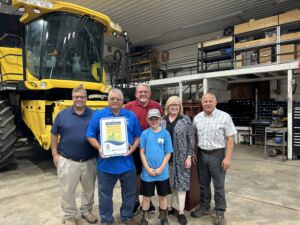
MDA Commissioner Thom Petersen (far left) attends a MAWQCP event at then President Bob Worth’s Lake Benton farm on Aug. 22, 2023.
Certification provides clarity in a landscape crowded with programs and shifting standards. The process begins with a comprehensive, whole‑farm assessment that considers nutrient use, tillage practices and soil health. Where adjustments are needed, conservation practices are implemented to meet water quality standards. In return, producers receive a 10‑year guarantee that their operation meets Minnesota’s requirements, even if there are future regulatory changes.
Endorsements in climate‑smart farming, integrated pest management, and soil health help producers demonstrate thoughtful, forward‑looking management in areas increasingly important to markets and supply chains. Many operations are experiencing this financial gain. Minnesota State colleges’ research recorded $50,600 higher average net income for certified farms compared to all other farms. These gains come from efficient fertilizer use, reduced fuel costs and the greater resiliency of healthy soil.
Farmers consistently tell us the process offers another benefit. Perspective. Certification offers a clear view, affirms effective practices and highlights opportunities for improvement. When adjustments are needed, the program connects participants with technical expertise and financial support. This is cooperation at work.
Looking ahead, Minnesota agriculture will continue to face weather variability, nutrient pressures, and water challenges. The MAWQCP is prepared to meet these demands because it is built on the strengths of Minnesota producers’ respect for the land and commitment to community.
To those already certified, thank you. Your work is strengthening the future of Minnesota agriculture. For those considering certification, I encourage you to connect with a local Soil & Water Conservation District and learn what the program can offer. It is voluntary, practical, and designed to support your operation’s success.
Minnesota agriculture succeeds when its producers succeed. I want to thank the Minnesota Soybean Growers Association for your continued support of the Minnesota Ag Water Quality Certification Program. The Minnesota Department of Agriculture and MAWQCP are here to work with you to advance productivity and stewardship acre by acre.