
MSGA calls for swift reallocation of RINs following EPA’s SRE decision
MSGA calls for swift reallocation of RINs following EPA’s SRE decision

When U.S. soybean farmers speak up, policymakers take notice.
After a strong advocacy push from Minnesota and the entire national soybean community in late August 2026, the Minnesota Soybean Growers Association (MSGA) and American Soybean Association (ASA) appreciate the Trump administration’s actions on 2025 small refinery exemption (SRE) petitions. The Sept. 1, 2026, announcement removes approximately 1.76 billion Renewable Identification Numbers (RINs) from Renewable Fuel Standard compliance for small refiners but proposes to reallocate 100% of those RINs to larger refiners in the current 2026-2027 period, thereby assuring no loss in biofuel demand.
Without 100% reallocation in the current period covered by EPA’s Set 2 Rule, ASA had estimated that biomass-based diesel demand would drop by 500 million gallons, and soybean farmers would suffer almost a $1 billion loss in revenue.
MSGA encouraged its members to use the Soy Action Center to urge the Trump administration to reject a dramatic expansion of small refinery exemptions and protect demand for American-grown biofuels. Ryan Mackenthun, president of MSGA, also sent a letter to USDA Secretary Ryan Mackenthun to warn of consequences the EPA’s potential action would have on family farms.
“A lot of my optimism over the past few months has come from the increased demand for biofuels and soybean oil, and without that certainty, soybean prices surely would’ve dropped as a result,” Mackenthun said. “We are grateful to our members and our fellow farmers from across the soybean industry for speaking with one voice and taking action to protect this critical market, and we appreciate the administration for responding to our concerns.”
ASA appreciates the intervention of President Trump, the U.S. Department of Agriculture and members of Congress, who highlighted the threat of SRE actions to biofuel feedstock producers and identified solutions to protect domestic soybean markets ahead of harvest. MSGA and ASA also thank the EPA for outlining the timeline to move forward with supplemental rulemaking before the end of October to hold soybean farmers and biofuel demand harmless by ensuring additional impacted volumes are 100% reallocated back into the historic renewable volume obligations finalized by the Trump administration in April.
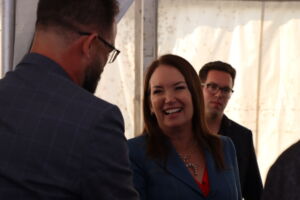
MSGA President Ryan Mackenthun visits with USDA Secretary Brooke Rollins during the 2026 Farmfest. As part of MSGA’s efforts to protect biodiesel demand, Mackenthun wrote a letter to Secretary Rollins.
“Soybean farmers greatly appreciate President Trump, Senator Grassley along with other biofuel champions in Congress, and USDA officials for sounding the alarm and working around the clock to ensure that soybean farmers and producers of homegrown biofuels are not negatively impacted by today’s SRE announcement,” said Dave Walton, ASA vice president and Iowa soybean farmer. “We appreciate the administration’s commitment to reallocating 100% of these additional exemptions and their intention to enter into supplemental rulemaking soon, but timing is critical. Any delay in reallocation risks undermining the domestic market demand that soybean farmers urgently need as we enter harvest season. EPA must move quickly to fully reallocate these RINs and ensure soybean farmers are held harmless.”
ASA also urges EPA to include 100% reallocation of updated expected SRE levels for 2026 and 2027. EPA proactively accounted for expected exemptions in setting those volumes, but SRE levels are now expected to be higher if new assessment methodology does not change. Addressing updated 2025–2027 SRE levels together would protect the integrity of the RFS and avoid the need for annual supplemental rulemakings.
MSGA’s leadership across more than two decades led in 2018 to Minnesota becoming the first state to adopt B20 (20% biodiesel) in the summer months. Today, biodiesel brings over 5,000 full-time jobs to the state. In total, the biodiesel industry has a $1.7 billion economic impact on Minnesota’s GDP, with $676 million in farm-level impact. For farmers, biodiesel add more than $1 to every bushel of soybeans and increases demand by 13%.